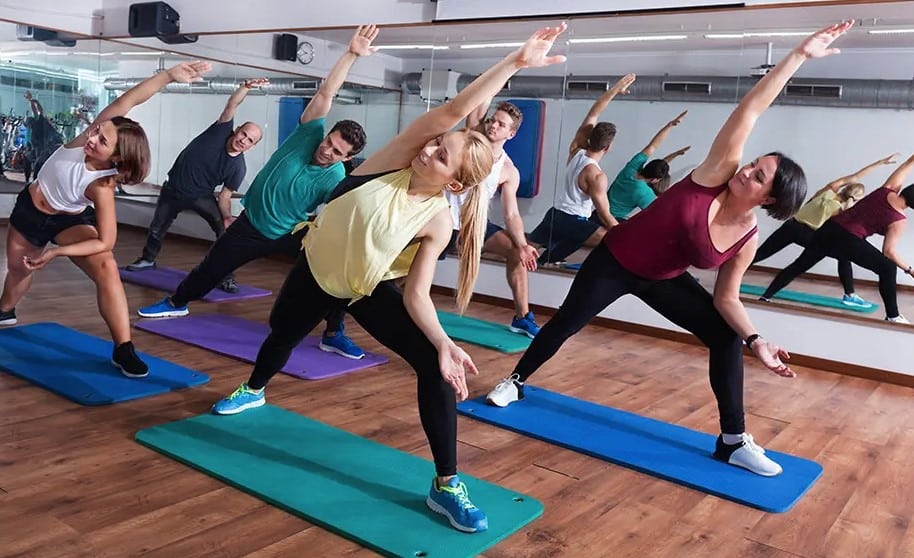



To become certified as a Group Fitness Instructor, you must pass an NCCA-accredited certification exam. The AFAA-GFI course content is designed to prepare you to pass this exam. The course is designed to be self-contained and to provide you with the necessary knowledge required to successfully pass this exam.
How it Works

Step1:
Study Your Online Course Material

Step 2:
Pass Your Proctored, NCCA-Accredited Exam

Step 3:
Become an AFAA Certified Group Fitness Instructor!
What You’ll Learn
– How to design, choreograph and lead a group fitness class.
– Foundations of nutrition and healthy eating.
– Training on modalities, including: strength and resistance, HIIT and interval, boot camp, yoga, cycle and more.
– How to adapt for special populations, like pregnant and senior participants.
– Essentials of exercise and physiology.
– Foundations of nutrition and healthy eating.

Curriculum
There are no prerequisites for this course, although a personal trainer certification or a fitness specialization is recommended.
Chapter 1: The Group Fitness Industry
Learn about the state of health and fitness today. This understanding will provide insight into why your pursuit of a career in fitness will help you become so influential in improving the lives of others.
Chapter 2: Foundations of Exercise Science
Helping others reach their fitness goals requires the knowledge to analyze the basics of human movement thoroughly. Biomechanics and the interactions of the muscle action spectrum provide you with the language of exercise science and a foundational understanding of the human body.
Chapter 3: The Human Movement System
Armed with the basics of biomechanics, you can now begin to learn the functions of the Human Movement System (also referred to as the kinetic chain). The kinetic chain is comprised of three different, yet intimately interwoven, systems that allow our bodies to move. The knowledge related to these systems and their interactions will help you guide the individuals you work with to move safely and effectively.
Chapter 4: Integrated Fitness
Integrated fitness is the foundation for the successful development of any fitness program, combining multiple types of exercise to help participants achieve their goals. Through the application of the various components of integrated fitness, you can design safer, more effective fitness classes.
Chapter 5: Teaching Basics
Using the principles of integrated fitness, you may now begin to piece together the five components of a workout for a unified class flow. Through an in-depth exploration of each of the five components (intro, movement prep, the body of the workout, transition, and outro), you can identify the various considerations for the most popular formats, including training intensities and appropriate exercise selection.
Chapter 6: Teaching Multi-training and Exercise Technique
One precious resource for an aspiring Group Fitness Instructor is a vast inventory of exercises that might be useful across multiple formats. Additionally, instructors should be familiar with the appropriate technique for each exercise they offer, as well as be prepared to offer modifications to accommodate participants' needs.
Chapter 7: Class Planning and Preparation
After understanding integrated fitness, the components of a workout, and appropriate exercises across popular formats, instructors can apply their knowledge in the classroom. Thoughtful class planning allows instructors the opportunity to refine the intended outcomes of their classes by selecting elements such as music, equipment, and movement options to best suit their intended goals.
2 Infographics
21 Videos
3 Quizzes
Chapter 8: Adapting to Class Dynamics
Instructors must do more than simply plan for their classes. They must also be prepared to encounter unexpected variables the day-of. Knowing how to respond to numerous situations, from surprise visitors to medical emergencies, will help you in your efforts to provide a safe and inclusive experience for everyone. Diligent classroom set-up can help avert complications before they begin.
Chapter 9: Communication and Learning
While in-depth knowledge of proper exercise execution and workout design is essential for all Group Fitness Instructors, the test of a genuinely successful instructor lies in connecting with participants through their preferred learning styles and active cueing. Generally speaking, the best way to connect with participants is by providing participant-centered instruction that acknowledges individual needs while still serving the group.
Chapter 10: Inclusive Instruction for Special Populations
Participant-centered instruction requires an understanding of the various levels of conditioning that may affect an individual’s performance in a group workout. By understanding the various considerations and modifications available, you can provide support for every participant without singling them out or sacrificing the quality of a workout.
Chapter 11: Class Engagement and Motivation
Effective instructors do more than offer safe movement experiences. They connect with their participants, which engages and motivates them to continue returning time and time again. By motivating every participant in a way that empowers them to meet their goals, you'll build value for your participants.
3 Infographics
28 Videos
4 Quizzes
Chapter 12: Professional and Legal Responsibilities
As with any career, there are legal, ethical, and professional expectations for certified Group Fitness Instructors. Included in these expectations is the need for continued educational and experiential development, as well as methods for self-care to help you sustain and thrive.
Chapter 13: Nutrition
Achieving optimal health and fitness goes beyond human movement, it also encompasses nutrition. Nutrition is an evolving and quickly changing science. As new research is conducted, new information provides fresh insights that may influence the work you do as a Group Fitness Instructor. This module will provide you the basic nutritional information you will need for discussions with participants, as well as to benefit your health and well-being.
5 Videos
2 Quizzes
After the completion of the course, you will have the option to take an online proctored final exam from the comfort of your own home, or in-office at a testing facility. The test consists of 120 multiple-choice questions. The exam is timed and cannot exceed 120 minutes. To pass, you need a score of 70% or higher. You will have 180 days (around 6 months) from your date of purchase and 1 attempt to pass. Additional retests can be purchased by calling Member Services. Requirements and limitations for retesting are described in the Candidate Handbook. Please contact the Member Services team for additional details regarding pricing and limitations.
How does training from the comfort of your own home sound? This program now comes with exclusive bonus content that teaches you how to train and manage clients virtually. Learn everything from setting up equipment, creating digital programs, taking payments and more! Course includes 5 in-depth lessons, a 10-part video series, and more.
Frequently Asked Questions
The exam is valid for 180 days (about 6 months) from your date of purchase. You will have access to the course content for 365 days from your date of purchase and as long as your account stays in good financial standing. This is particularly helpful so you can refer back to the content while you're first starting out as an instructor.
The AFAA-GFI course is completely self-paced. You have 180 days (about 6 months) to take the final exam from the date of purchase. Many students may complete the course in as little as 6 to 8 weeks. Exact times will vary depending on the student, prior experience and dedication to the material.
To support NASM's commitment to protecting health and safety, the AFAA-GFI certification must be recertified every two years.
As an AFAA-GFI, you are required to recertify every years. In order to recertify, you must complete 15 CEUs (continuing education units) as well as maintain a current CPR and AED certifications (worth 2 CEUs). CEUs ensure you're current with best-practice guidelines, plus they will expand your knowledge, skills, and abilities in key areas. To start the recertification process, please visit NASM's recertification and renewal page or AFAA's recertification page.
The final exam is administered online via a live proctor or in-office at a testing facility. It consists of 120 multiple-choice questions and 120 minutes for completion. You have 180 days (about 6 months) from your date of purchase and 1 attempt to pass with a 70% or higher. I
You do not need prior experience before taking the AFAA-GFI course. To sit for the exam, you must have a high school diploma or equivalent, and you must have current Emergency Cardiac Care (CPR) and Automated External Defibrillator (AED) Certification.
The AFAA-GFI certification is the foundation of a group fitness instructor. You will learn the latest instructional techniques, coaching skills, and leadership strategies for teaching safe, effective, and enjoyable group fitness classes no matter what the format is.